Study of the Long-Range Beam-Beam Interaction Simulation
Does it make sense?
30 October 2001
JAC
Goal: Use the injection-efficiency calculation of the
INJTRACK program to see if it behaves as expected when
the LRBBI simulation is turned on.
An expectation is that if we turn off PRZ13, which is
nominally set to -750 in newts5.in, then we would
expect the LRBBI to make the injection efficiency
much worse. The effect should increase with bunch
current, which is nominally set to 8 ma/bunch in
lrbbi_1.dat. The following studies all use the lattice
MORRIS_OLD_K9A18A000.FD96E_4S_15KG_INJ.
Here is the result for the injection efficiency as a function
of horizontal tune with LRBBI switched off for all nominal settings.
Bunch current is 8 mA/bunch. PRZ13 is set to -750.
The horizontal scale extends from 0.50 to 0.64.
The vertical scale extends from 0 to 100%.
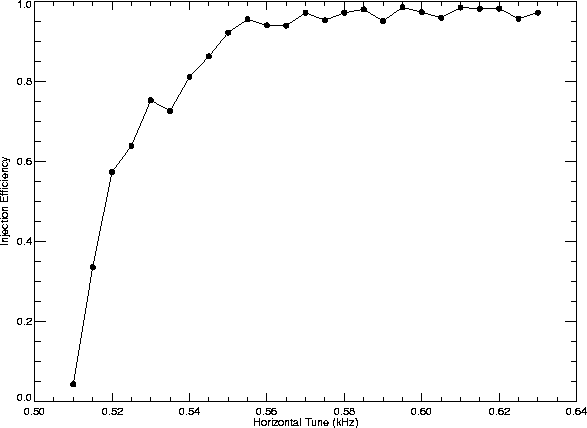
Now set PRZ13 to zero. Shouldn't the efficiency get worse? Doesn't seem to.
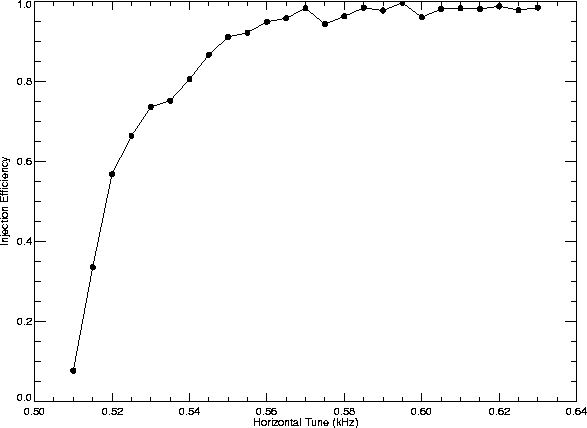
Now let's turn on the LRBBI. First we look at the effect of raising
the bunch current (left: 8 mA, right: 20 mA)
At high values for the tune, the efficiency gets dramatically worse.
Is this an indication that the LRBBI is doing something? Are there
any other bunch-current dependent effect? At present I don't have
a way of changing the bunch current when LRBBI are not switched on.
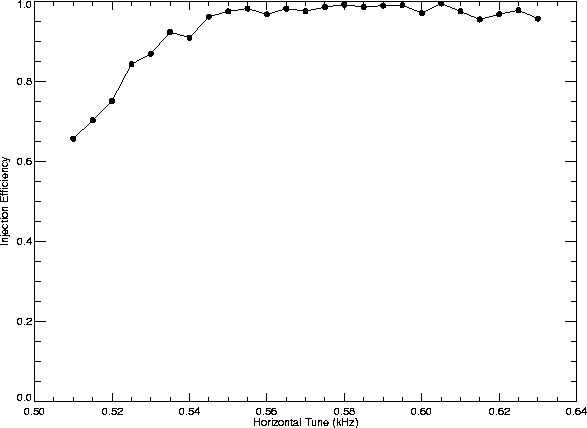
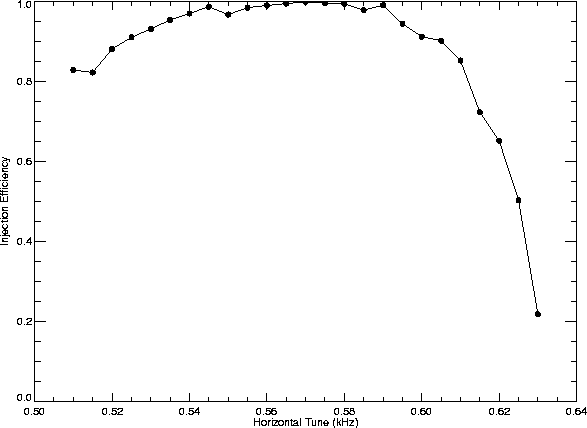
Now set PRZ13 to zero and make these plots for 8 mA and 20 mA again.
For a bunch current of 8 mA, there seems to be no big effect,
as also was the case with LRBBI switched off.
But for the high bunch current of 20 mA, turning off PRZ13 actually
seems to improve the efficiency, which doesn't make much sense (at least not to me).
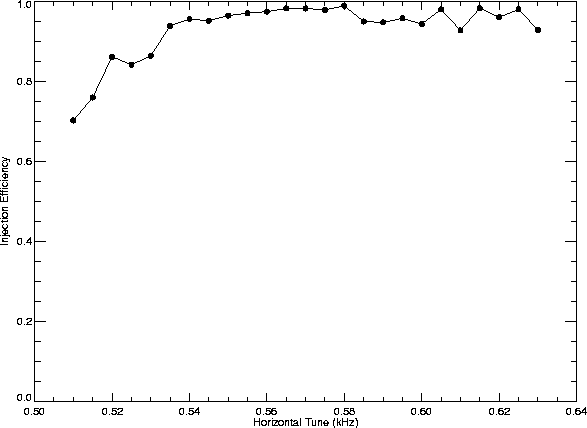
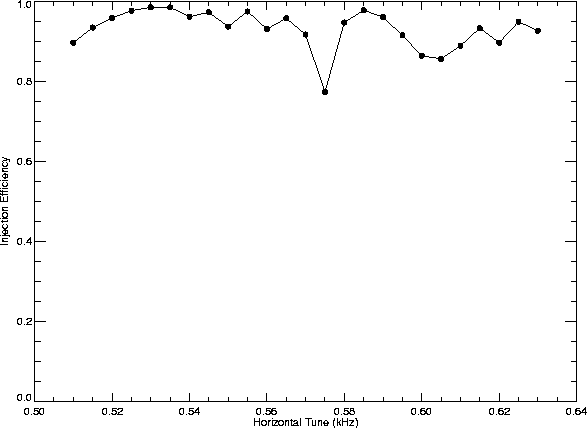
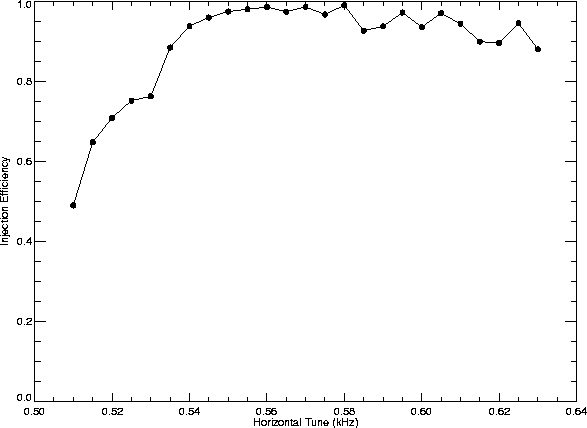
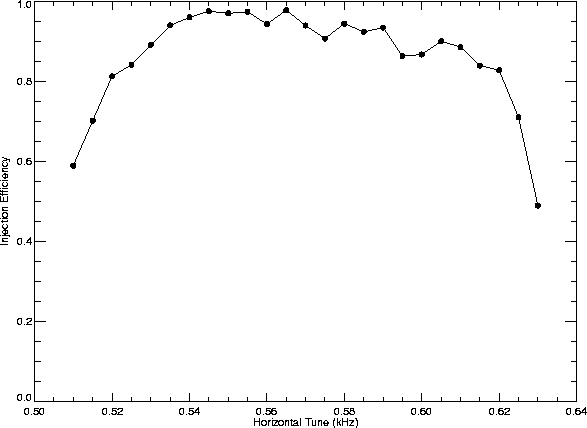
Now increase PRZ13 to -1500. The separation of the
parasitic crossing nearest the IP will be reduced compared to -750.
The efficiency is not much affected for 8 mA/bunch. For 20 mA/bunch,
the adverse affect at high tune values appears, but is not so
dramatic as at PRZ13=-750. So somewhere between 0 and -1500 this
effect of PRZ13 has a maximum.
Creation date: 30 October 2001