7-pole wiggler dynamic aperture
For the dynamic aperture tracking the taylor tracking method is replaced with
runge kutta integration through the vector fields table
/cdat/cesr38/disk1/critten/w7-20_22_fid.table
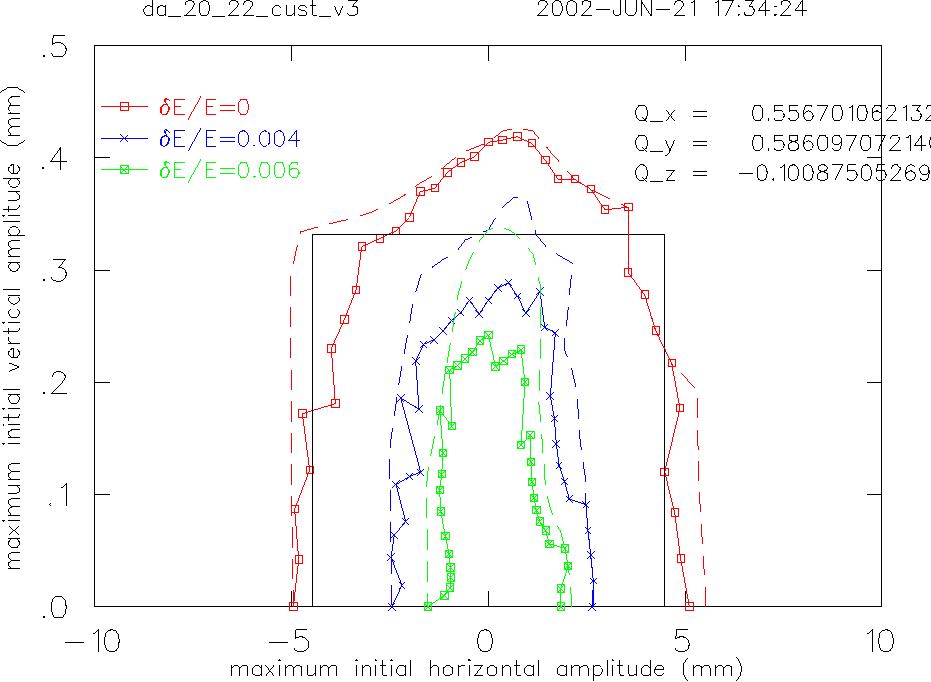
The choice of tunes is based on a tune scan with Q_z = -0.109. (V_rf = 10MV)
The curves with points indicate the maximum starting amplitude that
survives 1000 turns. Particles with amplitude outside the physical aperture
of the machine are considered lost.
The dashed lines indicate the maximum starting amplitude that
survives 20 turns and roughly
correspond to the linear/physical aperture.
Kickers are added to the lattice at either end of the wigglers and tuned
so that the closed orbit is flat with separators off. The pretzel is on of course
for the tracking. The solid line indicates 10 sigma_x with horizontal emittance =
0.2mm-mrad and vertical emittance = 0.1mm-mrad
------------------------------------------------
8-pole wiggler lattice -
The 14 wiggler linear lattice is designed using taylor
tracking and matrix calculation based on the fit dlr0310.in to the
vector fields data /cdat/cesr38/disk1/critten/w8-20_10_fid.table.
The name of the lattice file is
/cdat/cesr38/disk1/dlr/bmad_devel/dynamic_aperture/bmad_8pole_taylor_v3.lat
This is a preliminary optimization. The following are not quite right:
Crossing angle is 3.4mrad. That seems too big
The pretzel ampltitude is east-west asymmetric
Dispersion at IP is not zero and alpha* is not quite zero.
There is no constraint on emittance in the optimization. Software
had not yet been developed to compute emittance with the wiggler model.
The sextupoles give chromaticitiy near zero but have not been optimized. The
sextupoles are the same as for the 7 pole lattice.
Details of the linear lattice parameters are summarized
here
Note that whereas the lattice is designed using taylor mapping throught the wigglers,
the dynamic aperture is computed by runge kutta tracking through the tabulated fields. Linear
optical parameters may be distorted in the conversion.
8-pole wiggler dynamic aperture
For the dynamic aperture tracking the taylor tracking method is replaced with
runge kutta integration through the vector fields table
/cdat/cesr38/disk1/critten/w8-20_10_fid.table
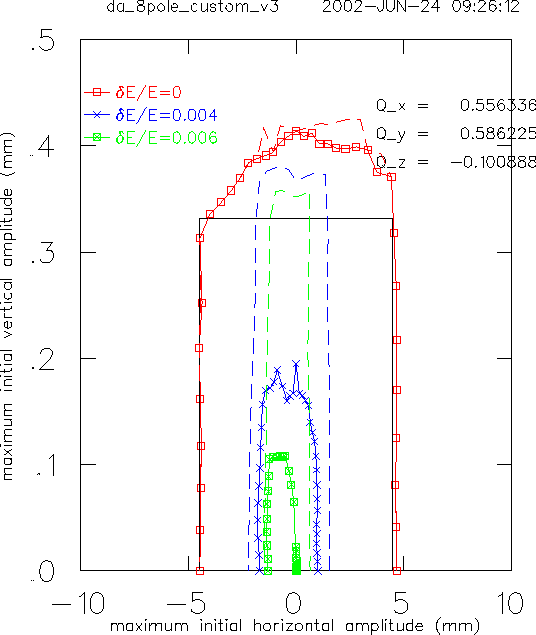
The choice of tunes is based on a tune scan with Q_z = -0.109. (V_rf = 10MV)
We use the same tunes as for the 7 pole tracking.
The curves with points indicate the maximum starting amplitude that
survives 1000 turns. Particles with amplitude outside the physical aperture
of the machine are considered lost.
The dashed lines indicate the maximum starting amplitude that
survives 20 turns and roughly
correspond to the linear/physical aperture.
The closed orbit with separators off is flat. No compensating kickers are
required. The pretzel is on of course
for the tracking.
-------------------------------------------------
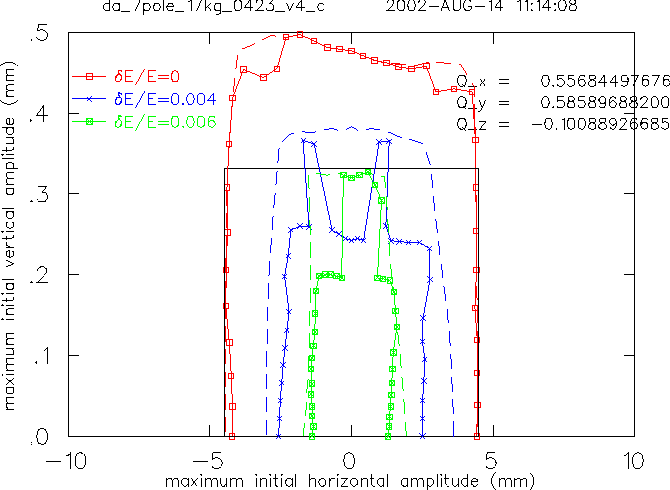
7-pole 17kg wiggler dynamic aperture 15-August-2002
Optimize da by first running sextz and then bmadz including
4X4det in figure of merit. Replace standard disp.dat with
disp_easy.dat. Otherwise off energy unstable.
bmad_7pole_17kg_0423_v4_c.lat
Details
DA postscript
Constraint files in ~dlr/bmad_devel/7pole_17
-------------------------------------------------
Underway - 1-July-2002
In order to remove some of the vagaries of the comparison of 7pole and 8pole
optics we are:
- Improving the linear lattice parameters of both sets of optics
and striving to make them as nearly equal as possible, including
- Pretzel amplitude
- Crossing angle
- Peak beta's
- Dispersion at IP
- Emittance
- Optimization of sextupole distribution for each lattice
- Create new optics with wiggler peak field of 1.7T and compare
dynamic aperture
-------------------------------------------------
8pole 21kg lattice - 17-september-2002
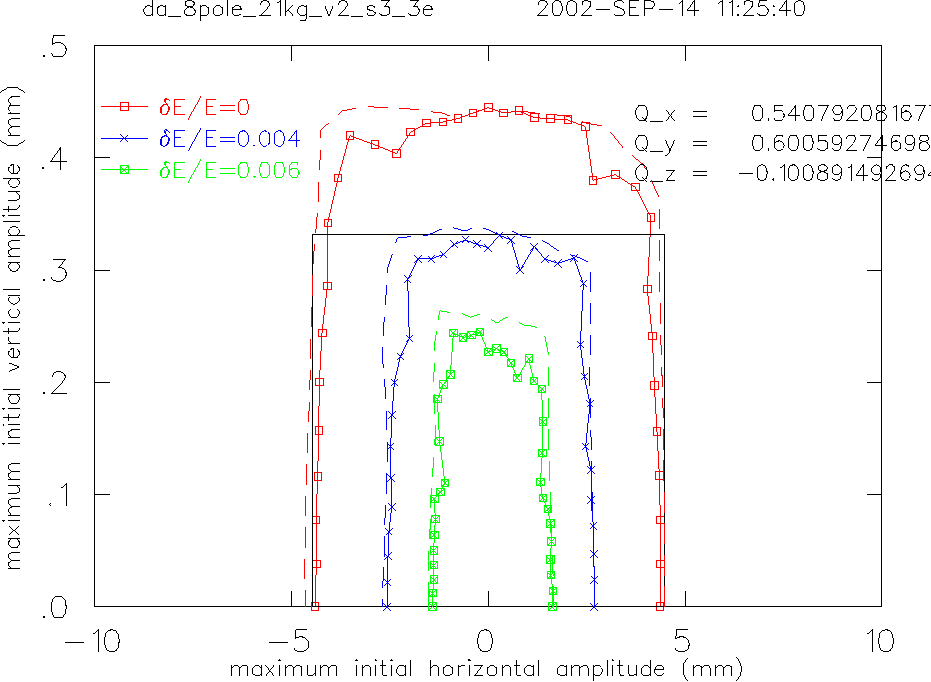
Based on the study of the phase space derived from runge kutta integration through the
vector fields table, as compared to the symplectic integration based on the fit to
the field table, and also remarks about runge kutta vs borsi integration, the symplectic
integration is likely a better representation of dynamic aperture. The lattice
bmad_8pole_21kg_v2_s3.lat and sextupoles are optimized (BMADZ) with symplectic integration through the
8 pole wiggler. The terms of the fitted function are in critten/w8-20_20_161_0621_009500.in
The fit is to critten/w8-20_20_161_fid.table.
Details of the lattice are here.
The dynamic aperture ((PS) is determined by
symplectic integration through the wigglers.