Wigglers
In L0, there is a 60cm quad (Q00) centered at the IP. There are 4, 2.1T wigglers east and 4 west of Q00.
Q01, also 60cm is placed between wigglers 2 and 3. Q02 is between wiggler 4 and the softbend.
We assume no other changes in the cesr layout. There is space for no more than 8 wigglers total between the
soft bends. All the details can be found in the lattice and
layout files.
Tune
The horizontal tune is 13.53 and the vertical tune, 9.58. The integer horizontal tune is chosen to minimize
emittance. An integer tune of 14 or even 15 might yield an even lower emittance, although at the expense
of dynamic aperture. Properties of a higher tune lattice have yet to be investigated.
Damping
The emittance is proportional to the radiation damping rate. With 8 2.1T wigglers and 2GeV beam energy,
transverse damping time is 67ms. As long as the wigglers are located where there is zero dispersion,
their addition increases the damping rate and decreases the emittance in proportion to their number.
If we can find space for the remaining 4 wigglers to bring the total
to 12 we would reduce emittance by 2/3. The corresponding straight between the soft bend magnets surrounding
L3 is a good candidate, but that would be somewhat more expensive (cryo lines) and has not been considered
further. But the inclusion of 4 wigglers in L3 is likely OK optically.
Lattice
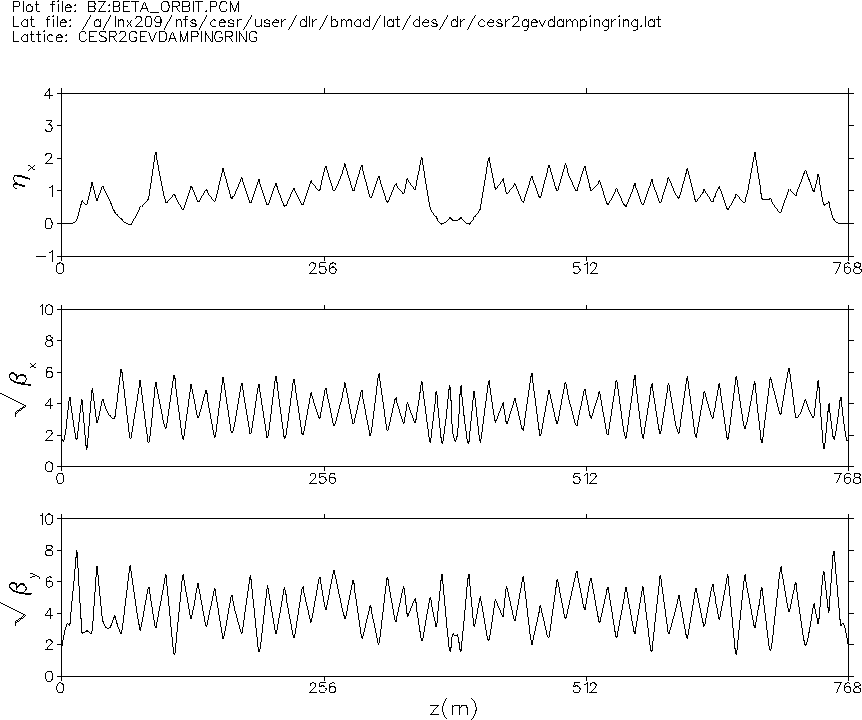
The lattice functions png , ps
and tabulated ,
are nearly symmetric about L3 but you can see
that the east and west flare are not the same. Dispersion is zero in L0 by design and in L3 by chance.
Lattice parameters are summarized in the table. An RF accelerating voltage of 3.2MV/cavity
gives the synchrotron tune and bunch length in the table. It actually might be difficult
to realize such a high voltage. Bunch length scales as 1/sqrt(Volts).
The strong vertical focusing of the wigglers wreaks havoc with vertical beta near L0. Q00 and Q02 are both horizontally focusing and very strong (k=0.57,0.43 respectively). (k(Q01)=-0.002, essentially zero). Perhaps some other arrangement of quadrupoles would be better.
| Parameter | Value |
| Wigglers | 8, at 2.1T |
| Beam energy | 2.0GeV |
| Energy spread | 8.4e-4 |
| emittance | 1.7 nm |
| Transverse Damping time | 67 ms |
| Qx | 13.53 |
| Qy | 9.59 |
| Qz | 0.098 |
| Bunch length | 7.5mm |
| Momentum compaction | 0.0071 |
Dynamic aperture
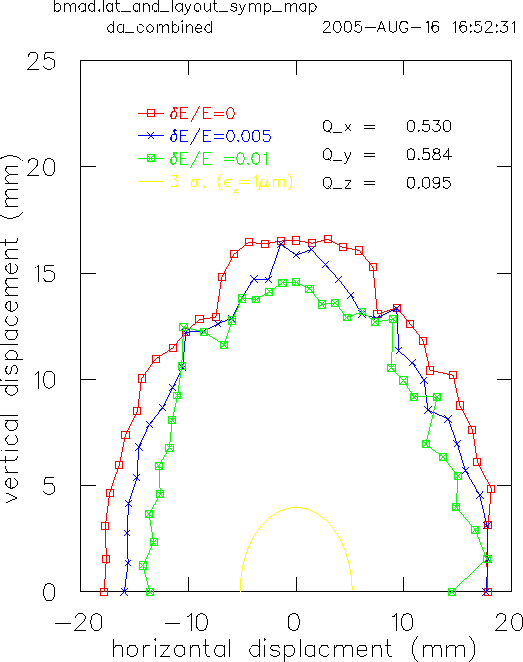
The dynamic aperture gif and
ps is computed for fractional energy
offset of 0.5% and 1%. Tracking is based on symplectic integration through the same wiggler
map as for CESR-c calculations. The tunes are indicated in the plot. Particles are considered lost
if their amplitude >> the real physical aperture. (This seems to be the
way linear collider damping ring people report dynamic aperture.) The smooth yellow
curve corresponds to 3sigma, where sigma is the rms size of the "injected" beam, which is
again the custom of damping ring afficiondos. The horizontal emittance of the injected beam is
assumed to be 1000nm, and fully coupled so that the vertical emittance is half the horizontal
(500nm), just like for the real ILC damping rings. (I believe this is also Jeremy's
custom.) And that is real physical
emittance, not normalized. So, it looks like this lattice has good acceptance. The
equilibrium emittance is 1000 times smaller.
Conclusion
The lattice described herein with 1.7nm emittance and has generous dynamic aperture
and seems to me an excellent candidate for damping ring studies. I suspect that
with some combination of more wigglers and/or higher horizontal tune, the emittance
can be reduced to less than 1nm. Perhaps the dispersion can be made to vanish at
the existing location of one of the wigglers, obviating the cryo plumbing question.
The momentum compaction would be further reduced at higher tune thus allowing the possibility of decreasing the bunch length to the 6mm spec. This needs to be investigated.
I do not know how to quickly calculate Touschek lifetime. And now that you mention it, that could be a serious problem. I vaguely remember the statement that it is a neglible effect at 5GeV. And I suppose it scales with energy. So it might limit bunch charge to 2/5 of ILC design value? But it will also scale with emittance and since the emittance in this lattice is a few times that of the ILC damping ring, we may have an OK Touschek lifetime after all. As long as the lifetime is long compared to about 7 damping times, (about 450ms)?