MPISF - Göttingen
Abt. Molekulare Wechselwirkungen, Proj. 413

Structure, Phonons, and Diffusion on the Surfaces of Insulators


Interactions of atoms and molecules with the surfaces of insulators

The investigation of insulating crystal surfaces using the standard surface science techniques is strongly hampered, because in most cases these methods employ electrically charged probing particles or leave the surface in an electrically charged state by removing ions or, in the case of photoemission experiments, electrons.
Many processes which are of importance in chemical technology and atmospheric chemistry on the other hand demand a better insight into elementary interactions of atoms and molecules with such systems. Helium atom scattering is a particularly useful tool to study insulating surfaces. The projectiles are not charged and it is, due to the small energies between 10 and 50 meV involved in the scattering, a genuinely non-destructive method.

One of the goals in the work of this group is to study the behavior and properties of molecular adsorbate layers on the surfaces of ionic crystals. By employing elastic and inelastic helium scattering one obtains information about the symmetry of the adsorbate phases, the vibrations of a completed layer or single adsorbed molecules, and on their binding energies. Further information can be gained from low energy electron diffraction (LEED) and Fourier transform infrared spectroscopy (FTIRS). The latter work is performed in laboratories at the universities of Hannover and Magdeburg (H.Weiß, U. Magdeburg and Hannover). The interpretation of the experiments has been supplemented by theoretical work on the interaction potentials by other groups.

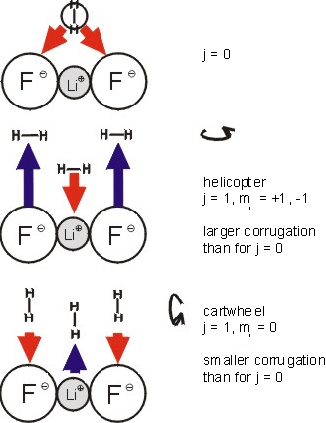
At the moment our interests are focused on molecular hydrogen adsorbed on the surfaces of NaCl und MgO. Because of the low temperatures (7 K) needed to bind the hydrogen molecules and their low mass, many properties of the adsorbate phases can only be understood in terms of quantum mechanical phenomena. If one compares layers comprising molecules in the rotational state j=1 with those in which the molecules are in the rotational ground state j=0, one finds that, while the adsorbate structures and the registry to the substrate are the same, the vibrations with respect to the substrate are different. The reasons are differences in the electrostatic interactions with the differently charged ions of the surface. These forces are sensitive to whether or not the molecules are rotating about a fixed axis.

Figure 1 illustrates this situation and shows that the influence of attractive (red arrows) and repulsive (blue arrows) forces between the differently charged ions and the charge distribution on the molecule depends distinctively on the rotational state and the orientation of the axis of rotation with respect to the surface. This picture also shows, that the apparent surface corrugation experienced by the molecule depends on its rotational state.

We have also investigated the adsorption of water- and acetylene molecules as well as N2, CO, CO2, and OCS on various substrates like NaCl, MgO, LiF, KCl.

Information on the molecule - substrate interaction can also be found from a scattering experiment in which the molecules are scattered from the clean substrate surface. The dependence of the surface corrugation on the rotational state of the projectile sketched above leads to differences in the diffraction patterns for molecules in different rotational states. This effect, first observed in this laboratory, can be used to determine local electric fields or the charge distribution on the surface.


Fig.1
The cartoon illustrates how the attractive (arrows pointing down) and repulsive (arrows pointing up) electrostatic forces between the ions on a LiF surface and a hydrogen molecules lead to a situation in which the molecules in different rotational states experience different apparent corrugations of the surface.


Literature:
[1] M.F. Bertino, A.L. Glebov, J.P.Toennies, F. Traeger, E. Pijper, G.J. Kroes und R.C. Mowrey, Phys. Rev. Lett. 81, 5608 (1998)
[2] A.L. Glebov, V. Panella, J.P. Toennies, F. Traeger, H. Weiss, S. Picaud, P.N.M Hoang und C. Girardet Phys. Rev.
B61, 14028 (2000)

Growing contiguous diamond films

Despite the great technological importance of growing diamond, the surface processes that take place during the synthesis of this material are by no means well understood. The most common method used to obtain synthetic diamond films is chemical vapor deposition (CVD) in which the deposited material is offered to the substrate in various excited states leading to a series of activated and non-activated surface reactions. In contrast to this situation, we are trying to restrict ourselves to non-activated educts and thus to reduce the number of possible reaction channels. The initial stages of homo-epitaxial film growth will be controlled using the helium scattering technique which provides information on structural and morphological changes of the diamond surface. The data will be supplemented by the results of infrared spectroscopic studies and information gained from atomic force microscopy.

Literature:
[1] M. Mehlhorn, Diplomarbeit, MPI für Strömungsforschung und Universität Göttingen 1999

Earlier work on insulator surfaces in the department


Present Staff


Alumni

  • Michael Mehlhorn
  • Dr. Alexei Glebov
  • Stephan Vollmer
  • Dr. Vania Panella
  • Dr. Gerrit Lange
  • Volkmar Senz
  • Dr. Rüdiger Vollmer

International Collaboration

  • . Prof. Dr. L. Bruch
  • . Prof. Dr. J. Skofronick
  • . Prof. Dr. G. Benedek
  • . Prof. Dr. C. Girardet
  • . Prof. Dr. G.J. Kroes


Back to the Homepage
last revision: E. Hulpke, Dec. 14, 2000; e-mail to Webmaster: mailto:Webmaster