
From Theory to Experiment. CLASSE Contributions Recognized in 2026 Breakthrough Prize in Fundamental Physics
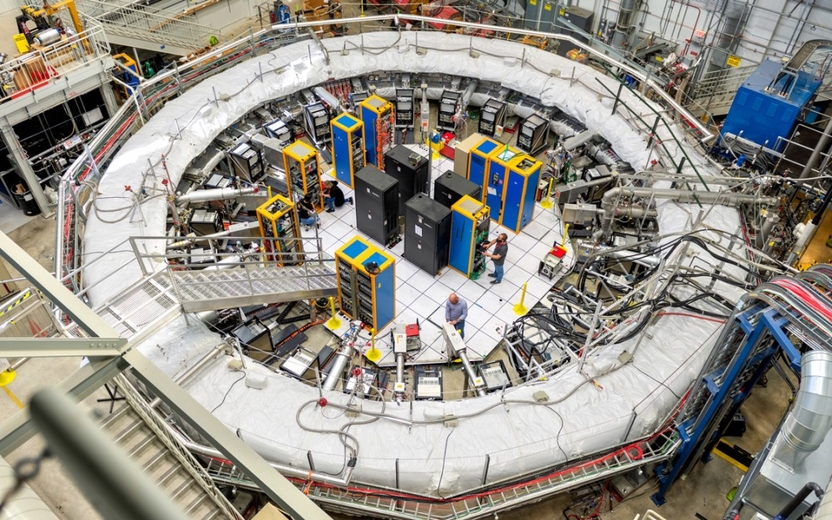
Researchers and technical staff from the Cornell Laboratory for Accelerator-based Sciences & Education, CLASSE, played key roles in the international muon g-2 collaborations that were awarded the 2026 Breakthrough Prize in Fundamental Physics.
The prize recognizes decades of work across experiments at CERN, Brookhaven National Laboratory, and Fermi National Accelerator Laboratory to precisely measure the anomalous magnetic moment of the muon, a quantity that provides one of the most sensitive tests of the Standard Model of particle physics.
Among those recognized is Cornell physicist Lawrence Gibbons, whose group at Cornell and CLASSE contributed to detector systems, electronics, firmware, beam instrumentation, and data analysis that enabled the experiment’s extraordinary precision.
“It was really gratifying to have the experiment recognized,” Gibbons said. “These small, high-precision experiments sometimes get lost in the shuffle compared to the very large collider experiments. But they open windows in very different ways into what else could be out there.”
The muon g-2 experiment measures how the muon, a heavier cousin of the electron, behaves in a magnetic field, where the measurement itself requires precision that was not yet possible.
While the experimental effort recently captured worldwide attention, Cornell’s connection to the science spans decades and reaches deeply into both theory and experiment.
Gibbons pointed to the late Cornell theorist Toichiro Kinoshita, whose pioneering calculations of quantum electrodynamics (QED) contributions to the muon and electron magnetic moments laid critical groundwork for the field.
“It was a tour de force calculation,” Gibbons said, of Kinoshita’s work. “He blazed the way on that, and it enabled the measurements to become very interesting because you could compare two extremely precise things against each other.”
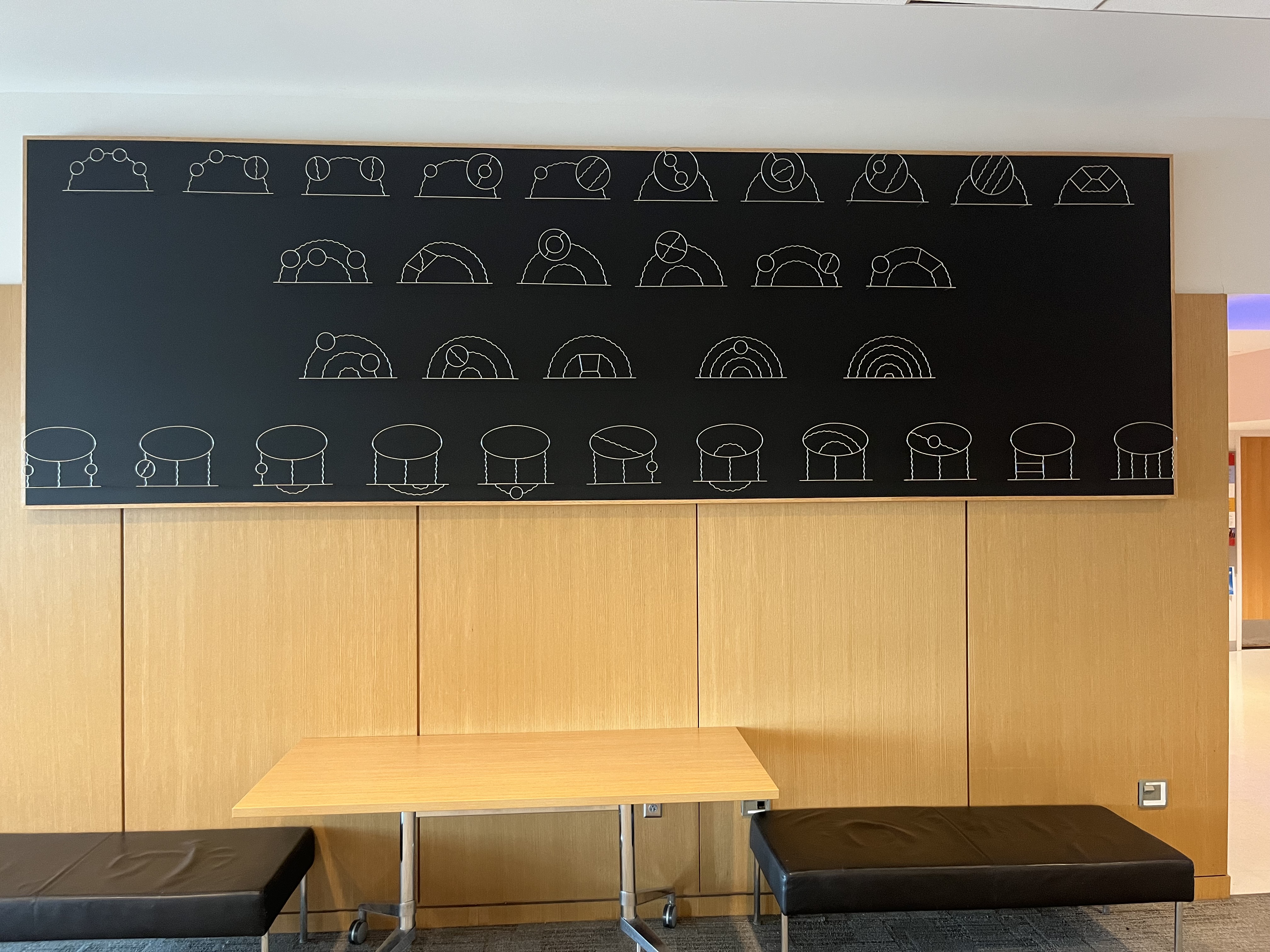
That longstanding theoretical connection remains visible within the Physical Sciences Building of Cornell itself. Outside the office of the CLASSE Director sits a sculpture inspired by the intricate Feynman diagrams used in g-2 calculations. Visual representations of the quantum interactions and particle fluctuations that contribute to the muon’s magnetic behavior.
On the experimental side, Cornell researchers and technical staff helped solve a wide range of challenges associated with measuring billions of muons with unprecedented precision.
Gibbons highlighted the work of CLASSE engineers Charlie Strohman and Nate Rider, who played central roles in developing the experiment’s high-speed digitizer systems used to read signals from the calorimeters.
“This experiment would not have worked without high-quality, fast, quiet digitizers,” Gibbons said. “We couldn’t have done it without them.”
Cornell and CLASSE personnel also contributed to firmware development, beam dynamics analysis, timing and trigger systems, magnetic kicker systems, reconstruction algorithms, and precision data analysis methods used throughout the experiment.
CLASSE accelerator physicist David Rubin played a key role in designing an advanced magnetic kicker system used to steer muons into stable orbit within the storage ring. Developed alongside collaborators including Alexander Mikhailichenko and Seungcheon Kim, the system had to deliver extremely fast, high-current magnetic pulses with nanosecond precision. This proved essential to the experiment’s success.
“The success of the experiment really reflects the work of incredibly talented students, postdocs, engineers, scientists, and technical staff. They made it possible,” said Gibbons, recognizing the collaborative environment of theorists, accelerator physicists, engineers, detector experts, and computing specialists working together across generations of experiments.
Even as the muon g-2 experiment concludes, some of the technology developed at Cornell is already finding new life. Gibbons is currently adapting firmware developed for the experiment for use in future precision physics experiments at the Paul Scherrer Institute in Switzerland.
Gibbons and Cornell collaborators are now preparing for the next generation of precision measurements through the PIONEER experiment, which will study rare pion decays with unprecedented accuracy in another search for physics beyond the Standard Model.
Notable CLASSE Contributions to the Muon g-2 Experiment
Among the many CLASSE personnel who contributed to the experiment were:
- Tyler James Barrett
- Robin Bjorkquist
- Antoine Chapelain
- Nic Eggert
- Zepyoor Khechadoorian
- Seungcheon Kim
- Kevin Labe
- Alexander Mikhailichenko
- Wren Osar
- Nate Rider
- David Rubin
- Charlie Strohman
- David Sweigart
- David Tarazona
- CLASSE IT