Machine studies


May 12, 2009

We stored a single 1 mA bunch in the high tune, 5GeV optics, and ramped the 6 superconducting wigglers in the L0 straight to 1.9T peak field. During the ramp we transitioned from the wiggler off quadrupole configuration to the wiggler on configuration. The horizontal orbit is erratic and uncorrectable in L0. Perhaps we need to adjust wiggler trim? Betatron phase correction was ultimately limited by quads Q2E and Q3W at their current limit. Radiation monitor trips limit total current to 5.5mA? Injection into the optics and lifetime is good. jshanks,dlr

May 13, 2009

We fit measured to design betatron phase using new optics with more conservative quad strengths. The orbit through L0 continues to exhibit a large displacement at 1W. Radiation survey suggests that x-rays from the wigglers are scattering in the beam pipe and over the shielding wall and tripping the radiation monitor.

May 14, 2009

Raise radiation monitor trip level. Add shielding around west end of wigglers. Store 40mA and measure electron cloud with RFA

May 16, 2009

Saturday, May 16, 2009 - low emittance machine studies
Flatten horizontal orbit and measure horizontal and vertical tune shift with sextupole change of 1000cu. CTA machine studies https://webdb.lepp.cornell.edu/elog/CTA+MS/158. The lattice is cta_2085mev_20090516.lat. Conversion to horizontal offset is shown. Each end of the error bar is based on one or the other of horizontal and vertical tune shift.

and on a more expanded scale


May 17, 2009

Sunday, May 17, 2009 - low emittance machine studies
Flatten horizontal and vertical orbit. Remove xbsm bump. Tune to coupling resonance (234kHz). Measure tune split vs sextupole change and translate to sextupole offset

Same as above but including orbit measurement butns.121119 and vertical steerings

We also measured lifetime - with feedback on.

and with feedback off. The long lifetime suggest large vertical emittance.

For reference, back in January we measured


May 22, 2009

May 22-24, 2009 Plan

Friday, May 22, 2009 - low emittance machine studies
Measure and attempt to correct dispersion, coupling and orbit using skew quads and vertical steerings. The fit converges measurement after loading corrections indicate coupling is worse than before. Restore original skew quads and measure lifetime. The touschek parameter is a bit smaller (1.8/1.6) than the measurements from a week before but still greater than we measured in January (1.5/1.2)


May 23, 2009

Saturday, May 23, 2009 - low emittance machine studies
With all sextupoles off, flatten orbit, measure and correct phase and coupling, then tune to coupling resonance. Vary strength of sextupoles at 10W, 45E, and 32W to measure tune split then minimize with vertical bump. There is no tune split observed at 32 and 45 after removing tune shift due to horizontal offset!!! The coupling from 10W is eliminated with 480cu of vbumping 16 (4.5mm according to CESRV)


May 24, 2009

Sunday, May 24, 2009 - low emittance machine studies
Remeasure sextupole induced tunesplit, this time correcting for tune shifts due to horizontal offset. Coupling due to 23W is compensated using vbump23 (424CU) which gives a vertical displacement of 3.7mm (after calibrating from orbit measurement). The displacement extracted from the tunesplit measurement (see plot below) is 3.9mm. How about that. Coupling due to 22W is compensated with vbump23 (334CU) or 1.0mm (according to model) compared to tunesplit measurement of 1.8mm. Not as close.

Next plot abs(tunesplit offset) - abs(butns.121199)

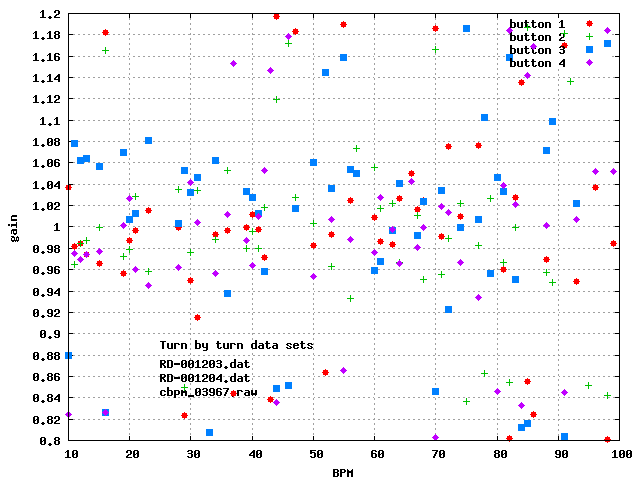
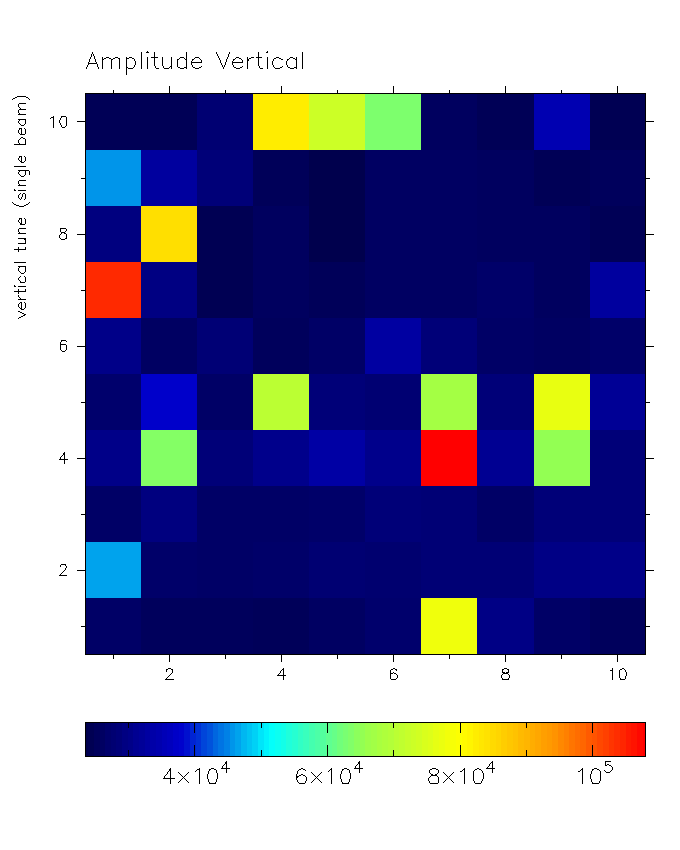
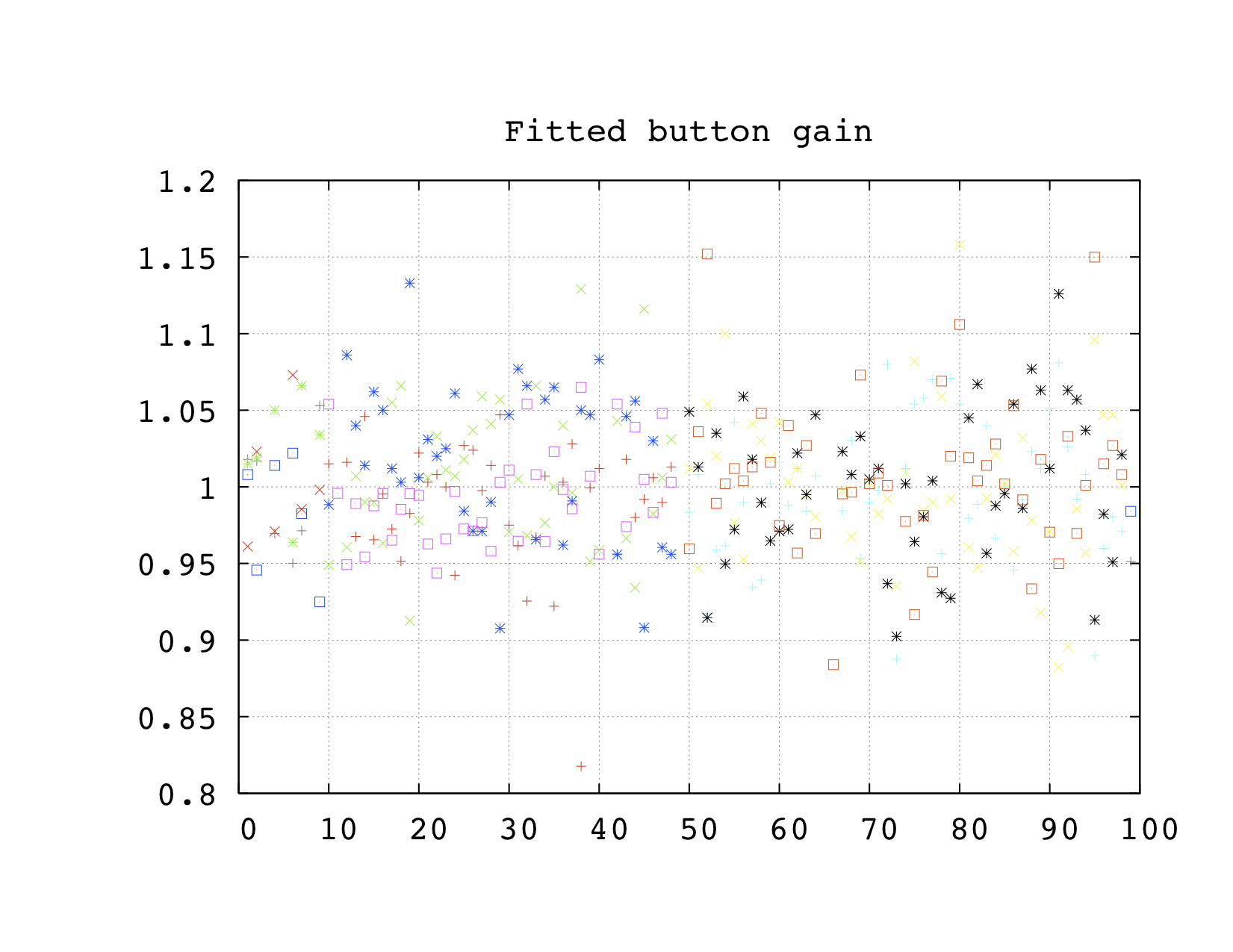
Gain mapping data was collected in a 3X3 grid at BPMs 9e and 10e.

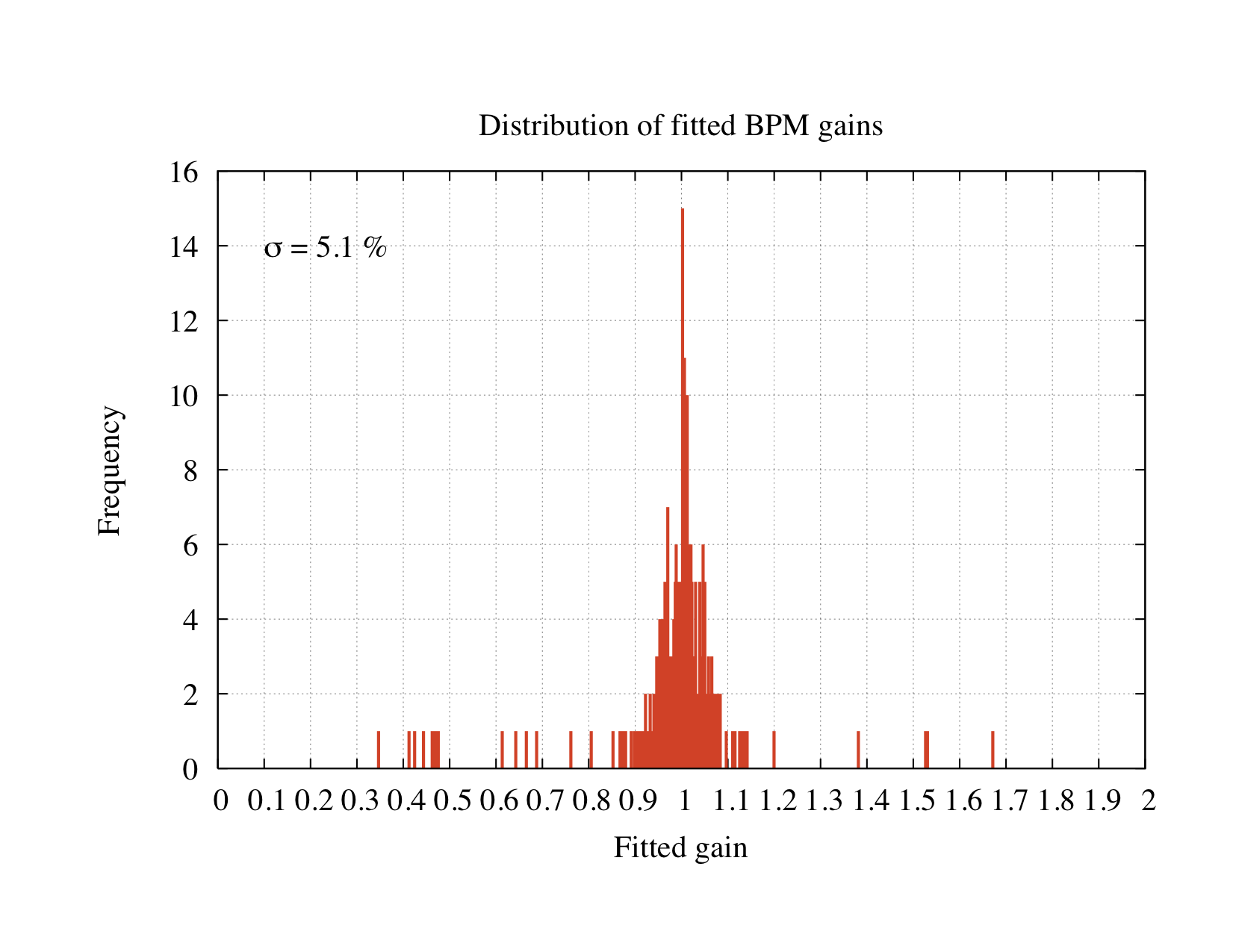
That's fair agreement, better for 9 than 10. 9 has a bigger range in y. But are 5% gain errors reasonable?


May 29, 2009

Plan

Friday, May 29, 2009 - low emittance machine studies
Load two family sextupole distribution and XQUNEING coefficients. Set chromaticity. The nonconvergence of flattening procedure and subsequent investigation finds mis calibration of horizontal steering 49E. Measure and correct phase and coupling. Check vertical offset of sextupole 23W vie tunesplit. Very small. Has the orbit changed that much since a few days ago? Load newly created bump coefficients. Fill 45mA for xBSM who reports poor image. Restore save set of 5/25 and image significantly better. Find that the major difference is the vertical orbit at the xbsm. When the vertical orbit is corrected, the image is OK.


May 30, 2009

Saturday, May 30, 2009 - low emittance machine studies
Confirm miscalibration of horizontal steering 49E. Debug gain mapping script for driving CESRV to map gains at secified BPMS using local bumps.


May 31, 2009

Sunday, May 31, 2009 - low emittance machine studies
Restore save set with 2 family sextupole distribution. Flatten to xbsm reference orbit in which BPMs 0-88 are set to zero. That is, the reference is dead flat except in the region of the bump. This is accomplished in CESRv with the command
"SET REF_ORBIT_X(0:88)=0"
and same for y. We flatten to the modified reference, then measure and correct phase and coupling. Change SEX 23W +1000 units (it is nominally 405) and remeasure coupling. The difference in the measured coupling corresponds to a ~1mm vertical displacment of 23W, which is in reasonable agreement with the measured orbit.

Then measure dispersion and fit to dispersion/coupling vertical orbit simultaneously using steerings and skew quads. Here is the list of CESRV commands as remembered a day later.

With two iterations RMS dispersion ~2.5cm and RMS coupling 1.1%. The 5-4mA time is 172.8 seconds. And the lifetime is plotted below. Touschek parameter is comparable to January.


June 1, 2009

Monday, June 1, 2009 - low emittance machine studies
Gain mapping
Close bumps and run cesrv script (/home/shanksj/CesrTA/cesrv_scripts/gain_map/cesrv_gainmap.in) to collect gain map data at detectors 9w,10w,23w. Turn off sextupoles 20W:25W to reduce tuneshift when bumps are changed. Bumps at 9E,10E are cut because steerings are limited (xbsm bump). Gain map data sets orbits [121369:121393]
In subsequent fitting add offset to list of parameters (offset and gain for each button)
Even though residual dispersion and coupling were small and liftime was short for 127218, xBSM reports broad signal. Could this be orbit? Vary betasing 1 to 100,200,300, 0

June 1, 2009 - xBSM
xBSM measures single pass size and centroid motion. An fft of the centroid motion shows that the most significant component is at the vertical tune. The data set is 10,000 turns so if there is a low frequency component (60Hz) we will need several hundred thousand turns to see it in the spectrum.


June 5, 2009

Plan 6/5-6/7

Friday, June 5, 2009 - LET xBSM
Tune xBSM white beam FZP slow scan height and width with HBUMPING 79,80 adn VBUMPING 71,73. We find significant improvement with +30CU HBUMPING 79 and +60CU VBUMPING 73. HBUMPING 79 is not well closed but 30CU generates 75 micron displacment and ~15microradian angle at source. VBUMPING 73 ~1 microradian angle at source (5E). (According to model). xBSM reports that signal quality (height and width) are now somewhat better than measured a week ago (5/29). We sure could use a number. The fitted lifetime and current vs time gives a touschek parameter smaller than we have measured previously.


June 6, 2009

Saturday, June 6, 2009 - LET xBSM

Restore csr 127269 from xray route. Flatten to 121430 from night before. Save 127271. Fill 20mA in 18 bunches.


June 7, 2009

Sunday, June 7, 2009 - 1.8GeV optics

1.8GeV optics - cta_1800mev_20090607.lat

Transition

June 8, 2009

Monday, 1- June 8, 2009 details where to find xBSM position and size data in CESR data base
Then 2- June 8, 2009 LET and xBSM
Measure and correct phase coupling dispersion orbit. Document and fill to 9mA in 9 bunches for xBSM


June 9, 2009

Tuesday, 1- June 9, 2009 and 2- June 9, 2009 - LET xBSM

Check orbit for xbsm. Find synch light mirrors are adjusted for poscsr set which has orbit 4mm high at 23E. Correct for xray set (with 0 offset at 23E). Monitoring xbsm centroid and size find that centroid is sensitive to betasing 1 and skew quads, but size is not.


June 12, 2009

Plan 6/12-6/13

Saturday, June 12, 2009 - LET xBSM
Collect gain map data for detectors 2w-8w
Measure and correct coupling and dispersion. Experiment with reference. Details of CESRV fitting are included. After fitting good xbsm signal is restored by adjusting vertical position using vbsaving 1. This adjustment yields much better signal, smaller beam size ???. Take a save set and a new reference orbit. Collect lifetime and beams size data as current decays from 5mA. Note that touschek parameter fitted to lifetime data and current data are in pretty good agreement, and smaller that measured in January, indicating a smaller beam size. The data file includes xbsm size but there is no change. Apparently it is no longer sending data.


June 13, 2009

Saturday, June 13, 2009 - 2.3GeV optics

Use CSR ENERGY to ramp dipole to 2.3GeV, REM adjusts PNMR parameters, locks signal and we save a biggrp. 127363. The normal bend field is 675.78 gauss.

Next, ramp and restore 1.8GeV conditions. Again adjust PNMR parameters, lock pnmr1 at 688.2 gauss and save biggrp 127364

Ramp and restore 2.085 GeV conditons, fill positrons and

Using LATCHING 2 (to transition from cta_2085mev_20090513_2fam.lat to cta_2300mev_20090608.lat), and CSR ENERGY, take beam from 2.085 to 2.3GeV. Having started at 2.085GeV with a flat orbit it is not necessary to further correct orbit through transition. At 2.3GeV, measure and correct phase with the same beam and recover injection.

Update CTA_2300MEV_4NS route.


August 6, 2009

Thursday, August 6, 2009 - 5GeV/6 sc wigglers
CTA_5GEV_6WIG - load 2 family sextupoles and XQUNEING coefficients. Correct phase and coupling. Measure zero vertical corrector orbit. Create XBSM bump. Analysis of zero corrector orbit below shows that much of the vertical ripple is eliminated by rolling B35W->-.95mrad and B36W ->-1.55mrad.


August 14, 2009

Friday, August 14, 2009 - 4GeV optics
The 4GeV wiggler off optics have horizontal emittance of 43nm with integer horizontal tune of 14. With 6 superconducting wigglers in L0 operating at 1.9T, emittance is 23nm.

With beam stored at 5GeV we ramped down to 4GeV making adjustments and saving conditions at intermediate points along the way. At 4GeV (pnmr(3) = 1519.50) we corrected the orbit, phase, coupling and recovered positron injection. After a ramp, there is no injection after brief tuning.


August 15, 2009

Saturday, August 14, 2009 - 4GeV optics
Ramp and restore 4GeV set that was created the day before. The pnmr does lock at 1519 as anticipated. Considerable tuning (arc steerings, quads, skew quads, in addition to transfer line) yields 200 turns at best. Very frustrating.


August 16, 2009

Sunday, August 16, 2009 - 4GeV optics
Begin where we left off the day before and quickly recover the same 100-200 turns but no stored beam. Abandon tuning of quads and vertical steerings from the past couple of days. Turn all vertical steerings off and load design quadrupoles from lattice. Then store beam with simple adjustment of xfer line and tunes. When there is finally enough stored beam to measure the tunes, we find that both are high by 35kHz. Retune, and then measure and correct orbit, phase, coupling. Ramp, recover injection and confirm that orbit and phase are OK. Then ramp L0 superconducting wigglers to 1.9T. Transition to wiggler on optics.


August 17, 2009

Monday, August 17, 2009 - 4GeV optics
Create xBSM orbit bump. Load coefficients for BUMP knobs to tune xBSM orbit. Tune electron injection.


August 18, 2009

Tuesday, August 18, 2009 Gain mapping
Collect gain mapping data for 23W configured as CBPM II


September 5, 2009

Saturday, September 5, 2009 Beam size
We measure beam size with the xBSM pinhole vs current and vs COUPLING_1. We see a reasonable correlation between beam size and COUPLING_1. COUPLING_1 is a combination of the 5 skew quads 2W:9W that generates a closed coupling bump. It also produces vertical dispersion that ripples around the ring. The computed beam size is plotted along with the measurement.
We see no current dependence to the beam size. We fill a single bunch to 5mA. The xbsm pinhole measurent is 28microns. Of course there is a significant dependence of lifetime on current. At 5mA lifetime is 9minutes.
Thinking that perhaps the xbsm with pinhole was at its resolution limit, we used 100cu of Coupling_1 to increase the beam size to 40 microns and again fill to 5mA.Lifetime at 5mA is 15 minutes. Again we see no change in beam size as the current decays.


September 6, 2009

Sunday, September 6, 2009 xbsm/CBPMII/ac_eta
xbsm alignment. CBPM II fixed vs variable gain. AC eta


September 7, 2009

Monday, September 7, 2009 Coupling/dispersion
Among other things, we have repeated measurements with CBPM II of phase and dispersion in a machine in which cbar is very small. The reproducibility on both i excellent, well within the requirements for achieving ultra-low emittance.


November 15, 2009

Sunday, November 15, 2009
Debug gain mapping script. Script OK. CBPM error.


November 21, 2009

Saturday, November 21, 2009 Gain mapping
Gain mapping with non destructive script. Repeated measurements of orbit and dispersion. Orbits 124073-124092 were measurement without changing the machine. The standard deviation of the position data at each BPM for the 20 measurements is 4 microns for vertical position and 5.2 microns for horizontal position. Here is a histogram of the standard deviations of the horizontal measurements at all BPMs in the 20 orbits
and the standard deviations of the vertical measurements at all BPMs in the 20 orbits
and the standard deviation at each bpm


November 22, 2009

Sunday, November 22, 2009
Repeated measurements of coupling and dispersion demonstrate reproducibility. Collect orbits in a grid for gain mapping.


November 23, 2009

Monday, November 23, 2009
Low emittance tuning procedure does not converge. Repeat with complete set of measurements. Experiment with correction strategy. Find xBSM insensitive to COUPLING 1 knob. Multiple coupling measurements. Load alternative optics and measure coupling and compare with measurements in original lattice to learn about BPM tilt. Correct coupling and fit BPM tilts. Measure lifetime. Twice what we measured in June.


November 30, 2009

Monday, November 30, 2009
Measure phase and coupling and dispersion with xBSM strip chart. Fit BPM tilts using coupling data and use them to correct dispersion. LET procedure. Measure a small increase in beam size on coupling resonance. Measure lifetime and measure Touschek parameter.


December 1, 2009

Tuesday, December 1, 2009 and more
Load coupling knobs and save biggrp
LET and then scan with coded aperture vs COUPLING 1

December 5, 2009

Saturday, December 5, 2009 and more
Load Zenthing and Betasing coupling and dispersion bumps. Characterize bumps with measurements of dispersion and phase. Measure beam size vs bump (betasing 3) Begin transition to big d optics. Measure 38 micron beam size with big d optics.

December 6, 2009

Sunday, December 6, 2009 and more
Measure beam size vs Betasing 3, 4 in big d optics (cta_2085mev_xr20m_20091205) Switch to standard optics cta_2085mev_20090516 and beam size drops from 36 mictrons to 16 microns. Measure ac_eta. Modify cesrv so that it sets Beta_rng paramter to N=2 for ac measurement. Measure ac_eta and dc_eta.

December 7, 2009

Monday, December 7, 2009 and
Lifetime and beamsize vs RF voltage


December 10, 2009

Thursday, December 10, 2009
xbsm c-line. Turn by turn data with shaking. Drive with horizontal and vertical shakers and then one at a time. Also excite with pingers and collect turn by turn. Motivated by Wolski normal mode gain strategy. Then measure phase and dc dispersion


December 11, 2009

Saturday, December 11, 2009
Develop bigd route. Get beam on xbsm. Try loading tiles from $d8/cesrv/opp_tilt.in. Measure eta Measure phase, ac_eta, coupling. Use LET correction routine. Difficulty loading corrections. Add design sextupoles. Try Helms correction algorithm. Beam size feedback on vs off = 45 microns vs 30 LET correction convergence.


December 12, 2009

Saturday, December 12, 2009
Turn by turn data with shaking. Drive with horizontal and then vertical shaker vs current. Measure coupling with sextupoles off. TBT data with longitudinal shaking.


December 14, 2009

Monday, December 14, 2009
Turn by turn data taking command. Measure beamsize vs betasing. Turn off all skew quads and measure phase. Correct and remeasure. Get electron injection. Calibrate a few vertical steerings. Zero corrector orbit electrons. Zero corrector orbit with sextupoles off.


December 19, 2009

Saturday, December 19, 2009 LET - convergence. Identify calibration errors with Q00 and vert 19w. Take ac_eta and correct cesrv ac eta measurement. Collect tbt data shaking longitudinally, vertically, and horizontally. Also horizontal and vertical at the same time. Then effective LET procedure. Finally remeasure phase, ac_eta, orbit, dc_eta


December 20, 2009

Sunday, December 20, 2009 xbsm slow scan
xbsm commands
zero corrector orbit
beam size vs current
beam size vs RF voltage
Lifetime vs RF voltage


December 21, 2009

Monday, December 21, 2009 xbsm electrons
Slow scan with FZP and white beam to measure electron beam size with feedback amplifiers on and then off, and at RF=3MV. LET. Measure zero corrector orbit 126075.


December 22, 2009

Tuesday, December 22, 2009 Beam size
Using fast scan xbsm measure positron beam size vs RF voltage, feedback amplifiers on and off, and tune. Measure zero corrector orbit 126106


February 2, 2010

Tuesday, February 2, 2010 Attempt turn by turn gain map. Flatten orbit. But then CBPM II do not respond to turn by turn command.


March 16, 2010

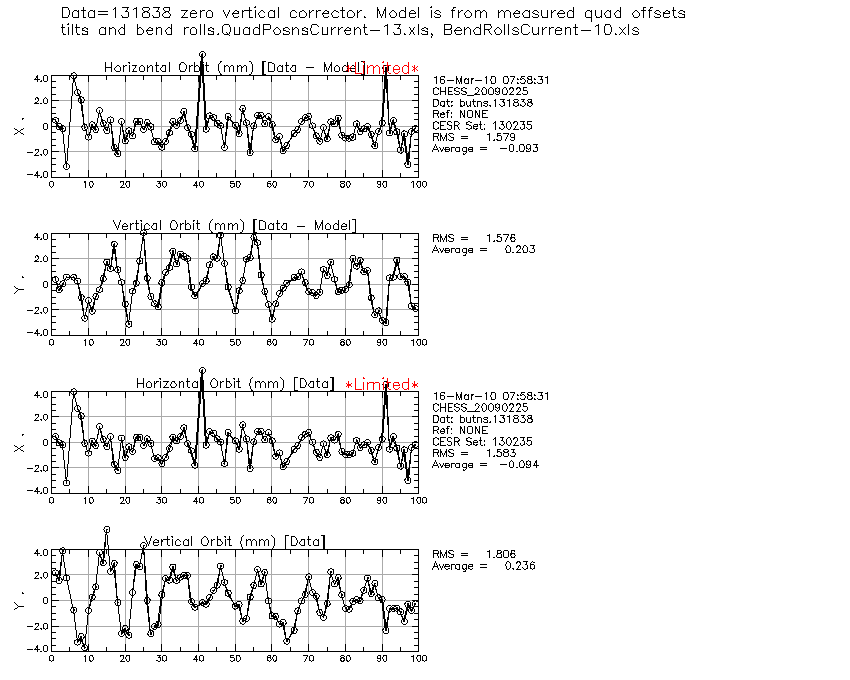
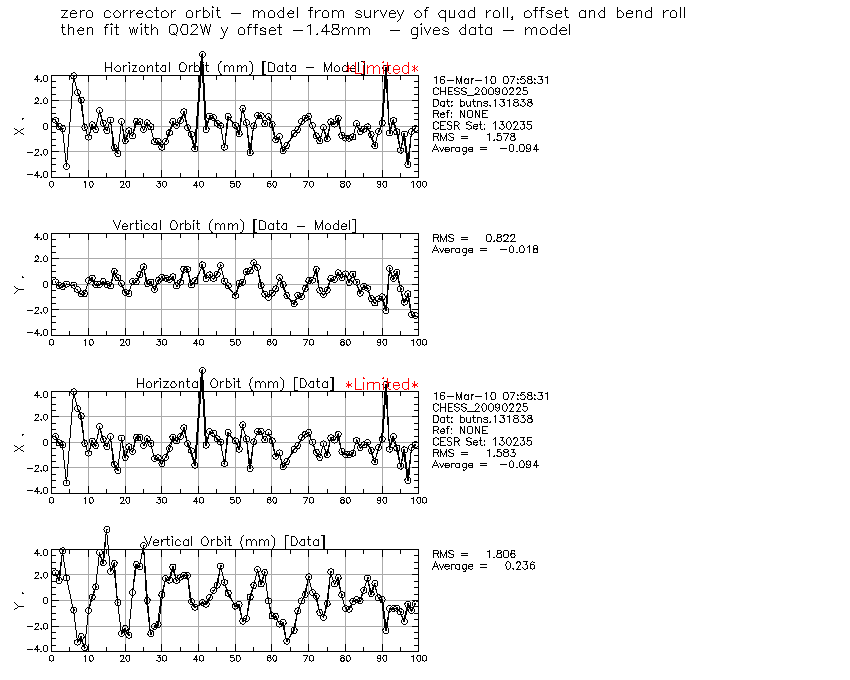
Tuesday, March 16, 2010 Zero corrector orbit in chess optics. Model orbit from latest survey data. Summary files in ~dlr/cesrv/survey/20100212/ data-model . The difference is mostly eliminited by shifting Q02w -1.48mm. data - model - fit Q02W


March 24, 2010

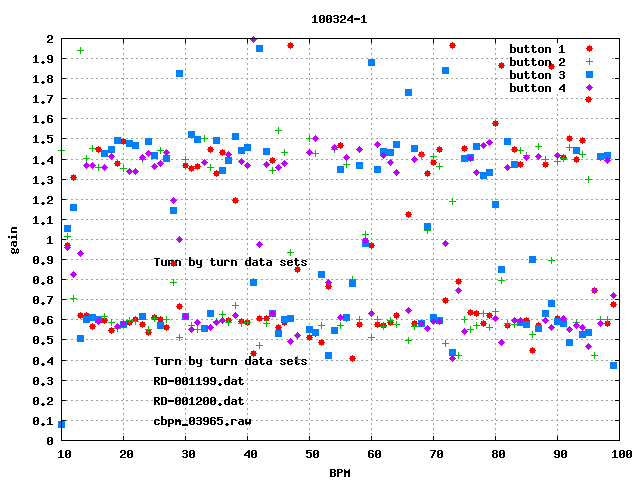
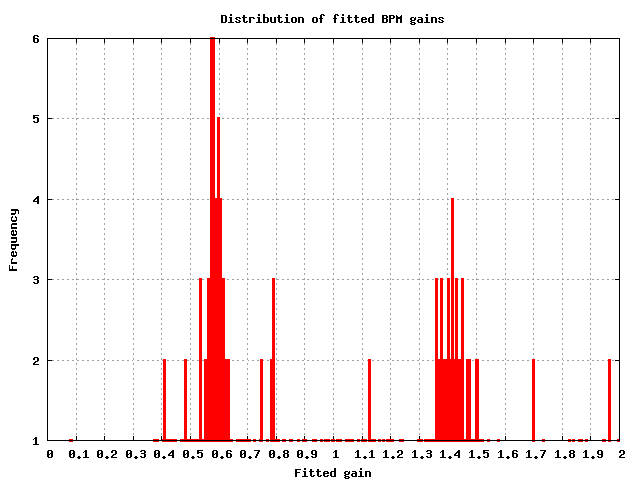
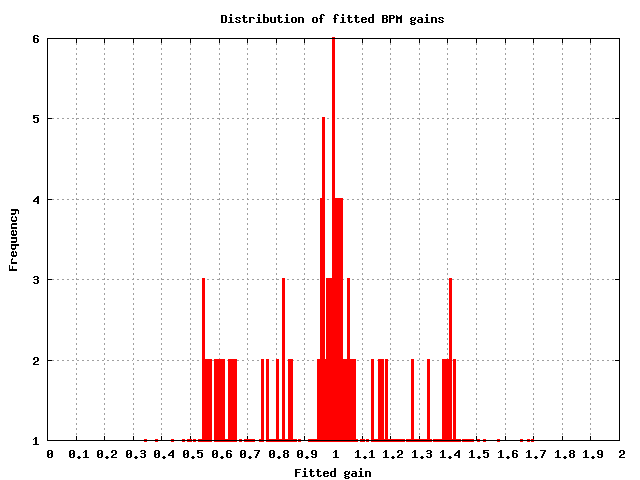
Wednesday, March 24, 2010 At 5.3GeV in CHESS optics, flat orbit, collect turn by turn data with and without shakers. Reduce data from all BPMs (CBPMI and CBPMII). At initial tunes - bimodal distribution of gains all_gain_100324-1 . as seen most clearly in the histogram-1

Lower horizontal tune to eliminate instability observed on synch light monitor and again collect turn by turn all_gain_100324-2 and histogram-2 It is not clear how (or if) the tune adjustment changed the quality of the data.

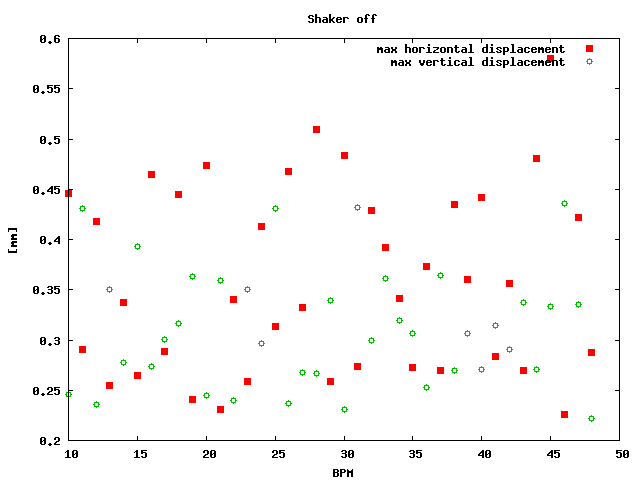
We also took some shaker off data, (before adjusting the tune) and it shows large transverse excursions which could be compromising the gain fitting data. Coasting displacements . If this is real beam motion then it should have no effect on the gain fitting. But if it is beam size variations or electronic noise it will.


March 25, 2010

Thursday, March 25, 2010 At 2.085GeVV in cta_2085mev_xr20m_20091205 optics. Debug tune scan software for measuring beams size with xbsm vs tune. Build tunescan on linux ~dcs/linux_lib/cesr_programs/cesr_tune_scan Test on 10kHz by 10kHz region of tune plane. Scan of vertical beam size. The wait time per measurement (3 seconds) was probably insufficient so we will need to increase it. The initialization file is ~dlr/tunescan/20100325/cesr_tune_scan.init

Flatten orbit while preserving d-line alignment

The procedure that works is to first measure the orbit (while observing a nice xbsm signal)

Turn by turn data Measure phase/coupling and ac_eta Finally use fitted gains to correct coupling and ac_eta data and the noise is indeed reduced, much more so in the coupling than the dispersion data. There was no time to correct phase/coupling/dispersion in advance so it is sloppy but the procedure seems to work. summary