Cornell University

CLASSE

CLASSE stands for Cornell Laboratory for Accelerator-based ScienceS and Education

News

Full listing

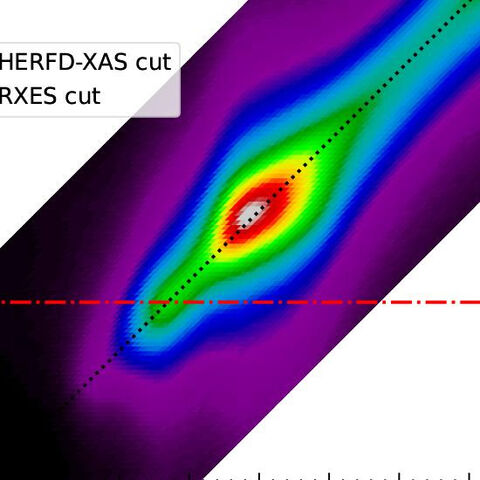
CHEXS users have directly observed an electronic configuration that is quantum mechanically mixed between the Yb2+ and Yb3+ valence states in the material YbB4. These observations confirm an “intermediate valence” conjecture for this material, which was first hypothesized 50 years ago.
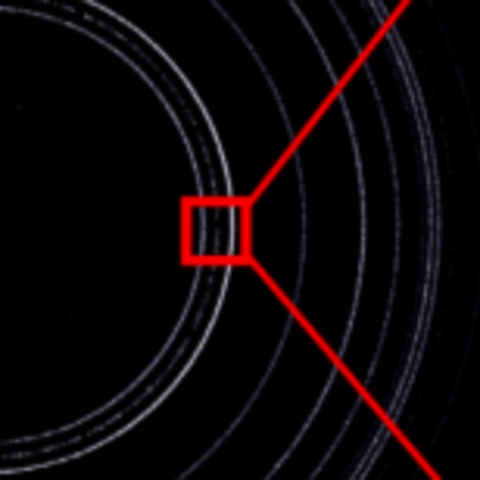
Recent research performed at CHESS presents new insights into the microstructural evolution which occurs during annealing of Mg alloys using in-situ X-ray diffraction.
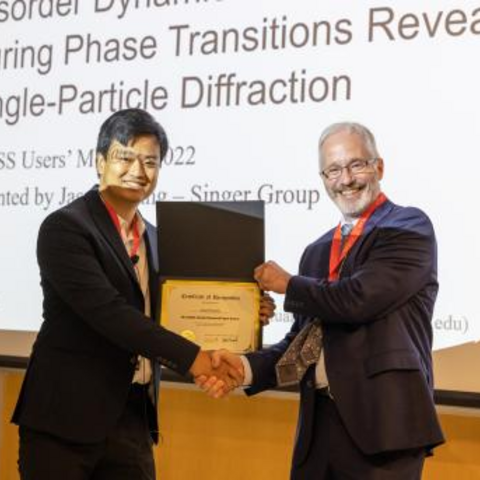
At the CHESS User Meeting, we recognized the best student paper and outstanding poster presentations based on research performed at CHESS during the past year.
The CHESS Users’ Meeting will be held in-person at the Physical Sciences Building at Cornell, with the option to view the meeting online via Zoom.
This workshop will identify forefront research opportunities for optical control of physical properties in biological, chemical, and materials systems.
Congratulations to Ashley Bucsek and Kushol Gupta!
Attend the meeting for updates on all CHESS facilities, science talks from CHESS researchers, and to network during breaks and the poster session.
Today, 60 feet below the Cornell University campus, at the Cornell High Energy Synchrotron Source (CHESS), researchers utilize X-rays that are 100 million times more intense than Röntgen's first beams of light.
The Cornell High Energy Synchrotron Source, CHESS, and the University of Puerto Rico are continuing a collaboration that will shape the future of the synchrotron X-Ray laboratory as it builds the new High Magnetic Field facility, HMF.
Hybrid pixel array detectors (PADs) have proven to be powerful, versatile area detectors for X-ray science. A new prototype would enable significant advances in time-resolved studies of dynamic phenomena.